
✨ This article was AI edited. Editorial responsibility: FoodFitnessFlora.blog.
Produced with AI. This article was artificially generated. Editorial responsibility: FoodFitnessFlora.blog.
Looking in the mirror and seeing what appears to be a segmented six-pack—only to touch your midsection and find soft, pinchable tissue—can be utterly bewildering. If you have ever wondered why does my stomach fat look like abs, you are experiencing an anatomical phenomenon known in sports medicine as “pseudo-abs” or compartmentalized subcutaneous adiposity.
Why Does Stomach Fat Look Like Abs?
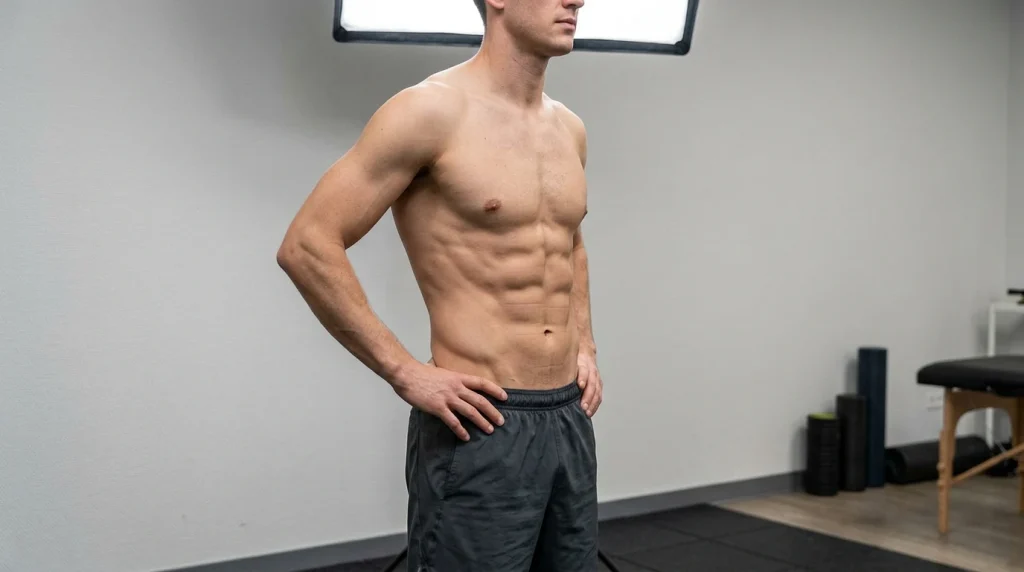
Stomach fat looks like abs when subcutaneous adipose tissue accumulates directly over the tendinous intersections of the rectus abdominis. These inelastic fibrous bands anchor the abdominal fascia firmly to the underlying muscle sheath. Even as body fat increases, the fibrous bands pull the overlying tissue inward, forcing the softer subcutaneous fat to bulge outward in discrete, pillow-like horizontal compartments that mimic muscular abdominal blocks.
The Anatomy Behind “Pseudo-Abs”
To understand why fat can form what looks like muscular abdominal blocks, you must examine the architecture of the anterior abdominal wall. Your “six-pack” is not six separate muscles; it is a single paired sheet of muscle called the rectus abdominis, running vertically from the pubic crest up to the sternum and ribs.
What creates the visual appearance of distinct squares are tendinous intersections (also called tendinous inscriptions). These are three or four horizontal bands of dense collagenous connective tissue that traverse across the muscle fibers. Crucially, these fibrous bands are tightly tethered to the anterior rectus sheath and surrounding superficial fascia.
| Characteristic | True Muscular Six-Pack | “Pseudo-Abs” (Fat Blocks) | Visceral Protrusion |
|---|---|---|---|
| Tactile Sensation (Touch) | Rock-hard, dense, and unpinchable when tensed | Soft, squishy, and easily pinchable (1+ inches of skinfold) | Tense and rounded, but cannot be pinched externally |
| Body Fat Percentage | Men: 8–12% | Women: 16–20% | Men: 16–24% | Women: 23–30% | Variable, typically accompanied by metabolic syndrome |
| Lighting Dependency | Visible in overhead, side, and flat diffuse light | Visible primarily in harsh overhead “downlight” shadows | Protrudes outward regardless of lighting angle |
| Structural Mechanism | Hypertrophied muscle bellies showing through minimal fat | Fat protruding between tethered tendinous inscriptions | Internal intra-abdominal pressure pushing muscle outward |
The 4 Primary Factors Creating the Illusion of Fat Abs
1. Tethered Fascial Anchors (Tendinous Inscriptions)
Because the tendinous inscriptions are non-compliant fibrous bands, they do not stretch outward when you gain weight. When dietary triglycerides are deposited into the subcutaneous fat layer, the fat cells (adipocytes) expand outward in the path of least resistance. Since they cannot expand directly where the fibrous band is anchored to the fascia, they mound up in the spaces between the bands, creating pillowy rolls that resemble abdominal muscle bellies.
2. Well-Developed Muscle Concealed Under Moderate Fat
If you regularly lift heavy weights, do compound squats, or have a background in gymnastics, martial arts, or athletics, your rectus abdominis muscle may be significantly hypertrophied (thickened). Even at 18% to 22% body fat for men or 25% to 28% for women, the underlying muscular ridges push outward against the fat layer, creating visible contours from a distance despite the layer of soft tissue over them.
3. Sedentary Posture & Flexion Creases
Spending 8 to 10 hours daily sitting at a desk slumps the torso forward, compressing the abdomen. This prolonged mechanical compression creates deep horizontal “creases” along the natural anatomical fold lines of the stomach. Over months and years, these creases become permanent collagen indentations in the dermis, dividing the abdominal fat into three horizontal tiers that can look deceivingly like segmented abdominal muscles.
4. Intra-Abdominal Visceral Pressure
Visceral fat accumulates deep inside the peritoneal space, surrounding the intestines. Unlike subcutaneous fat, which is soft and external, visceral fat exerts continuous outward hydraulic pressure against the abdominal muscular wall. If you possess developed abdominal muscles but also have elevated visceral fat, the entire midsection pushes forward like a barrel, making each abdominal block bulge prominently outward while feeling rigid underneath a soft superficial coating.
The 3-Step Self-Diagnostic: Real Abs vs. Pseudo-Abs
To accurately determine what you are seeing in the mirror, perform these three physical diagnostic tests:
- The Skinfold Pinch Test: Stand upright and pinch the skin directly over the center of one of your visible “abs” using your thumb and index finger. If the pinched fold is thicker than 0.75 inches (20 mm), what you are seeing is primarily compartmentalized subcutaneous fat resting on top of tendinous bands. Genuine six-pack definition requires skinfolds under 8–10 mm.
- The Isometric Flexion Test: Contract your abs as hard as you can while standing. Without relaxing the tension, press your fingers firmly into the protruding block. If your fingers sink softly into squishy, cool tissue before hitting a firm wall an inch deeper, you are experiencing pseudo-abs.
- The Supine Relaxation Test: Lie completely flat on your back on the floor. In a supine position, gravity pulls visceral fat and subcutaneous fat laterally toward your flanks. If your “abs” completely flatten or disappear when lying down and relaxing, the appearance is fat-based. True muscular abdominal bellies maintain distinct ridges even in supine rest.
How to Turn “Pseudo-Abs” into True Lean Abdominal Definition
If you have pseudo-abs, you actually have an enormous advantage: your body naturally compartmentalizes abdominal fat along your muscular lines, and your underlying rectus abdominis is likely already well-developed. Transforming this look into genuine, sharp abdominal definition requires three targeted actions:
1. Create a Modest, Systematic Caloric Deficit
You do not need to starve yourself. Implement a 350 to 500 kcal daily deficit below maintenance. Maintain this deficit consistently for 8 to 12 weeks. As total body fat percentage drops by 4% to 6%, the subcutaneous fat cells within the compartments will deflate, allowing the taut, vascular skin to adhere directly to the muscle sheath.
2. Shift Focus from Sagittal Crunches to Weighted Progressive Loading
Stop doing endless 50-rep sets of sit-ups. The rectus abdominis responds to progressive overload just like any other skeletal muscle. Perform exercises with heavy resistance in the 8–12 rep range: cable kneeling rope crunches, hanging leg raises with pelvic curl, and heavy weighted ab-wheel rollouts. Building thicker muscle bellies ensures that when fat drops, the blocks are prominent and crisp rather than flat.
3. Correct Anterior Pelvic Tilt and Slouched Posture
An anterior pelvic tilt thrusts the lower abdominal contents forward and exaggerates horizontal skin creases. Perform daily couch stretches to release tight hip flexors, strengthen glutes with hip thrusts and Romanian deadlifts, and consciously align your pelvis into a neutral position throughout the workday.
Frequently Asked Questions About Stomach Fat That Looks Like Abs
Is having pseudo-abs a sign of good or bad health?
Pseudo-abs are completely benign and largely cosmetic. They indicate that your anatomical tendinous intersections are pronounced and that you likely have decent underlying core musculature. However, if accompanied by a protruding hard belly (high visceral fat), it is advisable to improve cardiovascular fitness and insulin sensitivity.
Why do my abs look like they are there in overhead bathroom lighting but vanish outside?
Overhead directional lighting casts long downward shadows into the horizontal creases of your tendinous inscriptions, artificially exaggerating depth. In flat, outdoor sunlight, these artificial shadows disappear, revealing the smooth subcutaneous fat layer over the muscle.
Can bloating cause my stomach fat to look more like abs?
Yes. When intestinal gas or food volume pushes the abdominal wall forward, the muscular sheath stretches taut. This stretches the tendinous bands tighter against the skin while pushing the intervening fat outward, creating a temporary, pronounced segmented appearance.
At what body fat percentage do pseudo-abs become real abs?
For men, pseudo-abs transition into true defined abs between 10% and 12% body fat. For women, the transition typically occurs between 18% and 21% body fat, at which point the subcutaneous fat layer is thin enough that the hard, fibrous muscle tissue is felt immediately beneath the surface.
Conclusion: Demystifying Your Midsection Contours
Understanding why your stomach fat looks like abs removes the confusion and sets you on a clear path forward. You are not dealing with a medical anomaly; your tendinous intersections are simply doing their job of holding down your abdominal fascia while superficial fat fills the gaps. With a structured caloric deficit, heavy progressive core training, and postural awareness, you can strip away the soft cushion and reveal genuine, chiselled abdominal strength.
Získejte naše nejnovější články, návody a tipy přednostně ve vyhledávání Google a v AI přehledech.